Setting off loss from house property against salary income

In the budget for FY 2017-18, the Government of India introduced a proposal which reduces the extent to which loss from house property can be set off against other income including salary income. There seems to be confusion in the minds of some people as to how this proposal limits the tax benefit. The fact that some popular online publications have published incorrect information about this proposal has not helped the cause. This blog post attempts to throw some light on what the government proposed in the Finance Bill and how some have misunderstood the proposal.

Setting off loss from house property (prior to FY 2017-18)

In case of loss from house property, an employee could set off the same against his salary income without any limit. This was the rule prior to FY 2017-18. For example, if an employee’s loss from house property was Rs 6 lakh and his salary income was Rs 20 lakh, the employee needed to pay tax only on a salary of Rs 14 lakh (Rs 20 lakh minus the loss of Rs 6 lakh on house property).

The algorithm for setting off loss from house property against salary income is as follows.

Step 1: Calculate the annual value of the property (Section 23 of the Income Tax Act).

In case of self-occupied property: Rs 0.

In case of let-out property: Actual rent received/deemed rental value (as the case may be).

Step 2: Calculate the deductions (Section 24 of the Income Tax Act).

In case of self-occupied property: Actual interest payable or Rs 2 lakh, whichever is lower.

In case of let-out property: Actual interest payable (without any limit) plus other deductions such as municipal taxes paid.

Step 3: Calculate the loss from house property.

For each property, if the total deduction is more than the total annual value, there is a loss on the house property. Add up the profit/loss across properties and check if there is an aggregate loss on house properties.

Step 4: Set off loss under “Income from House Property” against the salary income (Section 71 of the Income Act).

In the event of an aggregate loss from house properties, set it off against the salary income. This reduces the taxable salary income. Please note that the set-off is available without any restriction. For example, if the loss from house property is Rs 8 lakh and the income from salary is Rs 8 lakh, the total taxable salary after set-off is Rs 0.

[notification style=”tip” font_size=”12px” closeable=”false”] To be clear, Section 71 of the Income Tax Act talks about setting off loss from house property against other heads of income (not just salary income). We refer to setting off against salary income since this blog focuses primarily on salary taxation.[/notification]

What does the Finance Bill 2017 change?

The Finance Bill 2017 does not restrict any of the deductions specified under Section 24 of the Income Tax Act. The Finance Bill simply restricts the extent of loss from house property which can be set-off against the salary income in a year, by way of an amendment to Section 71 of the Income Tax Act.

Following sub-section (3A) shall be inserted after sub-section (3) of section 71 by the Finance Act, 2017, w.e.f. 1-4-2018 :
(3A) Notwithstanding anything contained in sub-section (1) or sub-section (2), where in respect of any assessment year, the net result of the computation under the head “Income from house property” is a loss and the assessee has income assessable under any other head of income, the assessee shall not be entitled to set off such loss, to the extent the amount of the loss exceeds two lakh rupees, against income under the other head.

In other words, irrespective of the amount of loss from house property, the set-off shall be restricted to a maximum of Rs 2 lakh in a year. For example, if the loss from house property is Rs 8 lakh in FY 2017-18 and the income from salary is Rs 8 lakh, the loss from house property that can be used for set-off shall be restricted to Rs 2 lakh and the total taxable salary after set-off shall be Rs 6 lakh. This move will negatively impact employees with high salary who pay housing loan interest on multiple house properties. The reduction in tax benefit could be significant for some of the employees.

We reiterate that the Finance Bill does not restrict the deduction but only restricts the set-off. This distinction is important because the loss from house property, to the extent not set-off, can be carried forward for eight years immediately succeeding the year in which the loss is incurred and the loss can be adjusted against income chargeable to tax under the head “Income from house property” in subsequent years.

[notification style=”warning” font_size=”12px” closeable=”false”] The impact of the set-off restriction could be such that in certain cases the loss from house property may not be fully adjusted even in the subsequent years. In other words, some of the loss under Income from House property may never be fully utilized for the purpose of tax reduction.[/notification]

Incorrect media reporting

We find, somewhat surprisingly, many respected publications having incorrectly reported on this issue. Let us take a look at some of the incorrect reporting.

“Budget restricts tax benefit on second house to Rs 2 lakh,” reads a headline. This is incorrect since the Finance Bill makes no reference to the “second house.” The article pertaining to the headline gives one an impression that the benefit from let-out property shall be the same as that from a self-occupied property (Rs 2 lakh). This can be misunderstood as benefit (of Rs 2 lakh) from let-out property being available in addition to the benefit from self-occupied property (Rs 2 lakh). The fact is the total benefit (considering both self-occupied and let-out property) is restricted to Rs 2 lakh.

“Union budget 2017: Tax benefit on second house restricted to Rs 2 lakh,” reads another headline. The fact is that the benefit even from the first house (irrespective of whether it is self-occupied or let-out) is restricted to Rs 2 lakh.

We have also come across an instance where the tax calculator utility on the website of a leading tax-return service provider handles the set-off incorrectly and consequently making incorrect tax calculation for FY 2017-18. The calculator restricts the deduction on house property to Rs 2 lakh instead of restricting the set-off on account of loss from house property to Rs 2 lakh.

Please exercise caution while handling loss from house property declared by your employees for calculating salary TDS for FY 2017-18.

Read more

Reduction in PF administrative charges

The Ministry of Labour and Employment has reduced the PF administrative charges with effect from 01-Apr-2017. You can read the gazette notification here. The highlights of the notification are as follows.

1. The EPF administrative charge shall be 0.65% of the total PF wage from 01-Apr-2017. The earlier administrative charge was 0.85% (until 31-Mar-2017). Consequently, the administrative charges to be remitted under A/C No. 2 (PF admin account) shall undergo a change.

2. In case of non-functional establishments (covered under PF) with no contributing member, an administrative charge of Rs 75 per month shall be payable. A non-functional establishment is an organization which is not operational and hence may not have any wages payable to employees.

3. In case of functional establishments, if the administrative charge (calculated at 0.65%), is less than Rs 500, then the administrative charge to be remitted shall be Rs 500. For example, if the PF wages for a month is Rs 70,000, then the administrative charges, calculated as 0.65% of wages, works out to Rs 455 (which is less than Rs 500). Such establishments have to remit Rs 500 towards administrative charges.

4. The notification clarifies that the new administrative charges are applicable only from the wage period starting April 2017. In other words, administrative charges for periods up to March 31 should be calculated as per the earlier rates.

Changes to EDLI administrative charges

The notification also states that the Employees Deposit-Linked Insurance Scheme (EDLI) administration charges shall not be payable from 01-Apr-2017. The EDLI administration charges were 0.01% of the wages (or the minimum prescribed amount) until 31-Mar-2017.

Read more

Budget FY 2017-18 – Tax on Salary

The Union Budget for FY 2017-18 was tabled in the Parliament by the Finance Minister of India on 01-Feb-2017. Here are the key proposals related to computation of tax on salary which payroll managers need to consider for FY 2017-18.

1. A change in the tax rate.

The tax rate for the Rs 2,50,001 to Rs 5,00,000 salary slab changes from 10% to 5%. The rates for the other salary slabs remain the same.

The tax rates (for FY 2017-18) for salaried employees below 60 years of age are as follows.

Total Income for the Year in Rs Tax Rate in %
Up to 2,50,000 Nil
2,50,001 to 5,00,000 5
5,00,001 to 10,00,000 20
Above 10,00,000 30

The tax rates (for FY 2017-18) for salaried employees aged 60 years and above but below 80 years are as follows.

Total Income for the Year in Rs Tax Rate in %
Up to 3,00,000 Nil
3,00,001 to 5,00,000 5
5,00,001 to 10,00,000 20
Above 10,00,000 30

Note:
1. The Education cess including Higher Education cess stays at 3%.

2. Tax relief under Section 87A

The tax credit under Section 87A has been decreased to Rs 2,500 for FY 2017-18 (from Rs 5,000 for FY 2016-17) if the total income does not exceed Rs 3.5 lakh (reduced from Rs 5 lakh for FY 2016-17) for the year. This means that there will be no tax payable up to a taxable salary of Rs 3 lakh per annum.

3. A new surcharge

In case the total taxable income for the year goes beyond Rs 50 lakh (but is less than or equal to Rs 1 crore) in the year, a surcharge of 10% (subject to marginal relief) on the income tax is to be deducted – there was no equivalent surcharge in FY 2016-17.

In case the total taxable income for the year goes beyond Rs 1 crore in the year, a surcharge of 15% (subject to marginal relief) on the income tax is to be deducted – the surcharge was 15% in FY 2016-17 too.

4. Restriction of housing loan interest benefit.

In FY 2016-17, the maximum interest (on housing loan) benefit one could get on self-occupied property was Rs 2 lakh while for let-out property there was no ceiling on the interest benefit as long as the employee declared the rent (received or deemed to be received) as income from house property. For example, let assume that an employee owned 2 properties – one self-occupied and the other let-out.

1. If the employee’s interest payable on the self-occupied property was Rs 2 lakh, the benefit available on the self-occupied property was Rs 2 lakh.

2. If the employee’s interest payable on housing loan for the let-out property was Rs 6 lakh and he received Rs 3 lakh as rent, the benefit available on the let-out property was Rs 3 lakh.

In total, the employee could set-off the loss of Rs 5 lakh (Rs 2 lakh from self-occupied property and Rs 3 lakh from let-out property) against his salary, thereby reducing his taxable salary.

As per the 2017 budget, in FY 2017-18, the maximum interest benefit available on house property shall be restricted to Rs 2 lakh, irrespective of the number of house properties owned.

In the above example, the employee can set-off only Rs 2 lakh (even after considering both the properties) against his salary in the year FY 2017-18.

It may be noted that the unused benefit (beyond Rs 2 lakh) can be carried forward to subsequent years up to 8 years and set off against house property income in subsequent years.

This change is likely to increase the tax liability of many employees (especially those that draw a high salary) who have been claiming housing loan interest benefit on multiple house properties so far.

5. Phasing out of Rajiv Gandhi Equity Savings Scheme.

Currently, under Section 80CCG, employees who have invested in listed equity shares or units in equity oriented funds can claim deduction of 50% of amount invested to the extent such deduction does not exceed Rs 25,000 for three consecutive years (subject to certain conditions).

From FY 2017-18, no fresh deduction under the scheme can be claimed. However, those who have invested and claimed deduction earlier can continue to claim deduction for the next 2 years, until 31-Mar-2019, subject to conditions.

Read more

Reporting landlord & housing-loan lender PAN in the fourth quarter Form No. 24Q

Currently, employees who wish to avail HRA exemption are required to submit the PAN of their landlord(s) to their employer if the aggregate rent payment exceeds Rs 1 lakh in a year. Until FY 2015-16, employers were not required to submit information on landlord PAN to the Income Tax Department. This changed in FY 2016-17. As per the Income Tax Department notification dated 29-Apr-2016 (No. 30/2016), employers will have to report the PAN of the landlord in Annexure II of Form No. 24Q (fourth quarter) from FY 2016-17 onwards.

The Income Tax Department has notified the format of the fourth quarter Form No. 24Q in which employers should enter the following information.

Information Value
Column No. 357 – Whether aggregate rent payment exceeds rupees one lakh during previous year Value “Y” (Yes) or value “N” (No). This is a mandatory field in Form 24Q from FY 2016-17 onwards.
Count of PAN of the landlord Enter the total number of PAN of the landlords. The value in this field should be a positive number (greater than 0) and is mandatory when value “Y” is entered in the previous field (i.e. Whether aggregate rent payment exceeds rupees one lakh during previous year). No value is to be entered under this field in case “N” is the value in the previous field.
PAN of landlord 1** Structurally valid PAN of landlord 1 must be provided, only in case value “Y” is entered for the question, “whether aggregate rent payment exceeds rupees one lakh.” No value is to be entered under this field in case of value “N” (stands for No).
Name of landlord 1** Name of the landlord 1 must be provided. Value for this field is to be provided only in case “PAN of Landlord 1” is entered.

** There are 4 placeholders available for PAN and name of landlord (PAN of landlord 2 etc.) in Form No. 24Q. This means that PAN and Name details of up to 4 landlords can be provided.

What if landlord does not have PAN?

The Income Tax Department, by way of its salary TDS circular (No. 1/2017) for the financial year 2016-17, states that an employee can submit a No-PAN declaration by the landlord in case the landlord does not have PAN.

Section 5.3.9 in the circular states:

In case the landlord does not have a PAN, a declaration to this effect from the landlord along with the name and address of the landlord should be filed by the employee.

In other words, the revised Form No. 24Q data format which seeks landlord PAN information is in conflict with the above circular.

In case an employee submits a no-PAN declaration, an employer while submitting Form No. 24Q has to answer “N” (stands for No) to the question, “whether aggregate rent payment exceeds rupees one lakh during previous year?” currently. This would of course be misrepresentation of facts to the Income Tax Department. But there is no other option available to an employer.

Employers can enter only a structurally valid PAN in the PAN field. Ideally, the Form No. 24Q should allow employers to submit a value such as “PANNOTAVBL” in case an employee submits a No-PAN declaration. Incidentally, Form No. 24Q allows entry of “PANNOTAVBL” for employee PAN.

Problem with submitting housing loan lender PAN too

There is a similar problem with regard to submitting the PAN of housing loan lender. While Form No. 12BB requires employees to submit the PAN of certain categories of housing loan lenders (such as financial institutions and employer) only if PAN is available, the Form No. 24Q mandatorily requires PAN of the housing loan lender to be entered in case an employee seeks housing loan interest benefit.

Suggestion

Form No. 24Q should allow employers to submit a value such as “PANNOTAVBL” in case an employee submits a No-PAN declaration or if housing-loan lender PAN is not available. Incidentally, Form No. 24Q allows entry of “PANNOTAVBL” for employee PAN.

Employers will start filing the fourth quarter Form No. 24Q for FY 2016-17 in full earnest from 01-Apr-2017. We request the Income Tax Department to notify new data format for Form No. 24Q before April 2017 in order to address the landlord/housing-loan lender PAN issue.

UPDATE (22-Feb-2017):

The Income Tax Department has announced that landlord PAN is not mandatory for Form No. 24Q. In a release, the departments has said:

Validation for “PAN of Landlord” field has been revised for form 24Q-Q4 under Annexure II (i.e. Salary details) from F.Y. 2016-17 onwards.

Existing Validation of structurally valid PAN for field no. 41, 43, 45 and 47 has been relaxed. These fields may contain any value from the below mentioned when the landlord does not have PAN.

1 GOVERNMENT: This is applicable when landlords are Government organizations (i.e. Central or State).

2 NONRESDENT: This is applicable when the landlords are Non-Residents.

3 OTHERVALUE: This is applicable when the landlords are other than Government organization and Non-Residents.

Read more

Taxation when salary payment is deferred

A reader of this blog sent us the below question some days ago.

As per 192 TDS on salary is to be deducted on actual payment and not on accrual basis, here if a person resigns in Feb, his salary for the month of Jan and Feb is paid in April along with F&F settlement, then in which year it is accountable. As the payment is made in April [sic].

This is an important question which touches on one of the most fundamental issues in salary taxation – at what point in time should salary be taxed? When salary for the months of January and February is held back and paid only in April (a new tax year), how does Section 192 come into play?

A study of when salary should be taxed starts with Section 15 of the Income Tax Act. Let us take a look at Section 15 before we get to Section 192.

Section 15: Salary is to be taxed whenever it accrues or is paid, whichever is earlier

According to Section 15:

Salaries.
15. The following income shall be chargeable to income-tax under the head “Salaries”—

(a) any salary due from an employer or a former employer to an assessee in the previous year, whether paid or not;

(b) any salary paid or allowed to him in the previous year by or on behalf of an employer or a former employer though not due or before it became due to him;

(c) any arrears of salary paid or allowed to him in the previous year by or on behalf of an employer or a former employer, if not charged to income-tax for any earlier previous year.

According to Section 15, salary should be taxed as soon as it accrues, even if it is not paid then. When can one say that salary has accrued? For example, can it be said that salary for the month of January accrues on the last day of January?

Salary is said to have accrued when it can be claimed by an employee from a legal standpoint. Statutes such as the Payment of Wages Act specify the deadline by which salary will have to be paid to an employee after a wage period (say, a calendar month) ends. One could argue that salary can be said to accrue at the end of a wage period. Surely, right to receive salary payment arises only when accrual is deemed to have taken place.

From the perspective of the employer, if salary for January is charged as an expense for the purpose of accounting in the month of January, one could state that salary expense accrues in January for the employer. In other words, the employer explicitly recognizes that the salary income to employee accrues in January.

So, what does Section 15 say with regard to salaries that are deemed (even if not paid) to accrue in January and February?

According to Section 15, income tax on January and February salaries should be calculated as per the income tax rates prevailing in the relevant financial year. For example, salary for January 2017 and February 2017 should be added to the total salary income of FY 2016-17 and income tax should be calculated as per the tax slabs mandated for FY 2016-17. This holds even if the January 2017 and February 2017 salaries are paid in April 2017 (in FY 2017-18).

What about Section 192?

According to the Income Tax Department, “Section 192 casts the responsibility on the employer, of tax deduction at source, at the time of actual payment of salary to the employee. Unlike the provisions of TDS, pertaining to payments other than salary where the obligation to deduct tax arises at the time of credit or payment, whichever is earlier, the responsibility to deduct tax from salaries arises only at the time of payment.”

It follows from the above that since tax deduction needs to happen at the time of salary payment, the remittance of tax too needs to take place only after salary payment.

While Section 192 talks about the timing of tax deduction, the quantum of deduction itself should be only as per Section 15. For example, tax on salary which accrues in January 2017 and February 2017 (see the question posed at the beginning of this post) should be calculated on the basis of the tax rates in FY 2016-17 even if the salary is paid late in April 2017. Section 192 states that the tax – which is calculated as per the rates in FY 2016-17 – needs to be deducted only in April 2017, the time of salary payment. This is important because the tax rates for FY 2016-17 (the period of salary accrual) could be different from the tax rates for FY 2017-18 (the period of salary payment).

One can summarize that Section 192 specifies the timing of tax deduction while Section 15 specifies the quantum of tax deduction.

Actually, Section 192 is in a bit of conflict with Section 15 particularly in cases where salary payment is made late, in the next financial year. We think the text of Section 192 should be rewritten to clear the confusion. Please see our blog post in this regard. Section 15 is what determines how much tax should be deducted.

Practical issues in complying with Section 192

Even if salary for January and February is paid in the next financial year, the details of salary and TDS should feature in the fourth quarter Form 24Q of the financial year pertaining to the January and February salary. In case the fourth quarter Form 24Q has already been filed, one has to refile Form 24Q for the late salary payments.

Also, if accounting entries pertaining to January and February salary have to be finalised on time before the end of the year, the TDS amounts too have to be recognized in the books of accounts. However, this is not in line with Section 192 according to which the TDS payable arises only at the time of salary payment (in the next financial year).

Please note that, as a general rule, salary payment can be held back but payroll processing should never be stopped or deferred. For the months of January and February, PF, ESI and other statutory remittances can be made on time only if payroll processing is carried out without delay.

So, what do organizations do in case of delayed salary payment?

We find most organizations processing payroll and deducting/remitting TDS as soon as payroll is processed. This even if the net pay is paid along with settlement amounts at a later point in time. For example, in the example we are discussing in this post, the payroll of January and February salary shall be processed in January and February, and TDS for January and February shall be deducted and remitted to the Income Tax Department immediately. However, the net pay for January and February shall be held back and paid as part of settlement processing carried out in April.

While this is not fully in line with Section 192, this ensures compliance with Section 15 and that Form 24Q filing and Form 16 issuance are completed on time.

Some organizations misstate the period of accrual as the next financial year when salary payment is deferred to the next financial year. For example, let us assume that an employee’s last working day is 3rd of March and his final settlement consisting of March salary is processed in April. Some organizations calculate 3 days’ salary pertaining to March, state the same as April salary and include it in the income for the financial year in which settlement is processed. Of course, this is incorrect from the point of view of Section 15 of the Income Tax Act.

Ideally, organizations should aim to complete payroll/settlement processing without any delay. This would ensure compliance with income tax and other laws to a large extent.

Read more

Taxability of per diem allowance while on business travel

Organizations pay what is called per diem (per day) allowance to employees who travel for business purposes. The allowance is meant to help employees cover daily expenses pertaining to food, local travel, etc. When employees travel abroad they receive the allowance in foreign currency. Many organizations do not seek information on the actual daily expenses incurred by the employees. In other words, employees are not required to submit receipts (proof of expenditure) for the per diem allowance they receive.

Are per diem allowances non-taxable? If yes, are there are any conditions to be met for the allowance to be non-taxable?

Income tax and judicial authorities have gone through the matter of taxability of per diem allowance in a variety of cases. Let us take a look at the key issues in this regard.

Per diem allowance while on business travel is non-taxable

If the nature of a per diem allowance is as per Section 10(14) of the Income Tax Act along with Rule 2BB of the Income Tax Rules, then the per diem allowance shall not be included in the Total Income of the employee for the purpose of calculating tax on salary.

Section 10(14) states that an allowance should be “specifically granted to meet expenses wholly, necessarily and exclusively incurred in the performance of the duties of an office or employment of profit” in order to be exempt from tax.

Rule 2BB(1)(b) states that “any allowance, whether, granted on tour or for the period of journey in connection with transfer, to meet the ordinary daily charges incurred by an employee on account of absence from his normal place of duty” shall not be taxable.

In Saptarshi Ghosh, Kolkata vs Department Of Income Tax (ITA No. 915/Kol/2010), a Kolkata bench of the Income Tax Apellate Tribunal (ITAT) went into the issue of applicability of Section 10(14) and Rule 2BB to the taxability of per diem allowance in great detail. The bench examined the terms of the agreement (between the employee and the employer in the said case) under which employees were sent abroad for business purposes and concluded that “keeping in view the entirety of the facts and circumstances of the case, assessees were to be treated on tour and, therefore, eligible for claiming deduction under section 10(14)(i) read with Rule 2BB(1)b).”

Since the per diem allowance is not taxable, there is no requirement on the part of the employer to deduct TDS on such payments. The Andhra Pradesh High Court in Commissioner Of Income-Tax vs Coromandel Fertilisers Ltd. (Equivalent citations: 1991 187 ITR 673 AP) stated that if an employee is not liable to pay tax under the head “Salary” for a payment received by the employee, the obligation to deduct tax (by the employer) under section 192 does not arise.

Should the expenses be verified by the employer?

Judicial and tax authorities have ruled that an employer need not verify the exact nature of the expenses incurred by an employee, for the per diem allowance to be tax exempt. The Income Tax Department, by way of a circular (No. 33 (LXXVI-5) dt. 01 August 1955) has said:

Special allowance or benefit being reasonable and not disproportionately high–No details of expenses actually incurred need be asked for the purpose of granting exemption under Section 4(3)(vi) of 1922 Act.

In other words, as long as the allowance is within “reasonable” limits, the employer need not seek details of the expenses. Experts believe that the above circular is currently relevant even though it is based on the Income Tax Act of 1922. In Madanlal Mohanlal Narang vs Assistant Commissioner Of Income Tax (Equivalent citations: 2007 104 ITD 190 Mum, (2006) 101 TTJ Mum 1005), a Mumbai bench of the ITAT stated that the circular of 1955 is valid even in the context of the Income Tax Act, 1961.

8. The above circular was undoubtedly issued under the IT Act, 1922 but then all the circulars issued under Section 1922 Act do not cease to hold good in law. Section 297(2)(k) specifically provides that notwithstanding the repeal of IT Act, 1922, amongst other things, any instructions issued under any provisions of the repealed Act shall, so far as not inconsistent with the corresponding provisions of IT Act, 1961, deemed to have been issued under the corresponding provisions of the new Act, and shall continue to remain in force accordingly. In other words, to the extent the legal provisions of 1922 Act and 1961 Act are in pan materia, circulars and instructions issued under the 1922 Act will also hold good.

What is a “reasonable” per diem allowance?

Authorities say that per diem allowance is not taxable as long as the payment is a reasonable amount. Now, how does one conclude what is reasonable? Is a per diem allowance of USD 100 reasonable? What about, say, USD 300? There is nothing etched in law as to what a reasonable allowance is.

In Income Tax Officer (TDS), Vs. M/s. Symphony Marketing Solutions India Pvt. Ltd. (ITA Nos.874, 1252 & 1586/Bang/2014), a Bangalore bench of the ITAT, while hearing a matter pertaining to per diem allowance, accepted the prior ruling of CIT (Appeals) who said:

There is no monetary limit prescribed and hence unless such allowance is said to be fictitious or abnormally high or otherwise taxable in the hands of the employee, no liability could be fastened under Section 192 on the employer to deduct tax on such allowance. Moreover, it is also not possible to collate bills for every minuscule expenses and mere non-collation of bills in support of amount expenses cannot prevail over the fact of incurring such expenses.

The CIT (Appeals), in the above case, went through a couple of circulars (No.Q/FD/695/1/90 dated 11/11/1996 and No. Q/FD/695/2/2000 dated 21/09/2010) issued by the Ministry of External Affairs, Govt. of India and concluded that the per diem allowance of USD 50 to USD 75 paid by the assessee to its employees on official trips to USA and Europe was reasonable and that the same would be tax exempt under Section 10(14) of the Income Tax Act. The circulars referred to here, issued by the Ministry of External Affairs, specify the per diem allowance payable to government officials when they travel to different countries. The authorities, in this case, determined the reasonableness of the per diem allowance by referring to the allowance paid by the Indian government.

When the above case was escalated to The High Court of Karnataka (ITA 653/2015), the honourable judges accepted the above arguments and ruled that the per diem allowance, as long as it is reasonable, is not taxable.

Read more

TDS on Salary – Circular for FY 2016-17

The Income Tax Department has issued the “TDS on Salary” circular for FY 2016-17. You can take a look at it here.

Please ensure that all tasks (income tax deduction, investment proof scrutiny, etc.) related to salary TDS compliance in your organization for FY 2016-17 are carried out as per the circular.

Para 4.6.5 in the circular

This para states that the employer should receive and scrutinize documentary proof supporting investment declarations made by employees. Para 4.6.5 states:

To bring certainity and uniformity in this matter, section 192(2D) provides that person responsible for paying (DDOs) shall obtain from the assessee evidence or proof or particular of claims such as House rent Allowance (where aggregate annual rent exceeds one lakh rupees); Leave Travel Concession or Assistance; Deduction of interest under the head “Income from house property” and deduction under Chapter VI-A as per the prescribed form 12BB laid down by Rule 26C of the Rules.

In the above excerpt, the phrase “where aggregate annual rent exceeds one lakh rupees” in the context of collecting proof for providing House Rent Allowance (HRA) exemption is striking. To our knowledge the Rs 1 lakh cut-off is relevant only with regard to obtaining landlord PAN (or a no-PAN declaration by the landlord). However, this phrase gives one the impression that employer needs to collect proof (house rent receipt etc.) for providing HRA exemption only if the aggregate rent exceeds Rs 1 lakh. In other words, this seems to imply that employers need not collect any proof for HRA exemption in case the aggregate annual rent does not exceed Rs 1 lakh.

We are of the view that “where aggregate annual rent exceeds one lakh rupees” refers only to submission of landlord PAN and employers will have to collect house rent receipt even if the rent paid is less than Rs 1 lakh. As you may be aware, currently, employers need not collect rent receipts only if an employee receives a monthly amount of Rs 3,000 or less as house rent allowance.

Para 4.9 in the circular

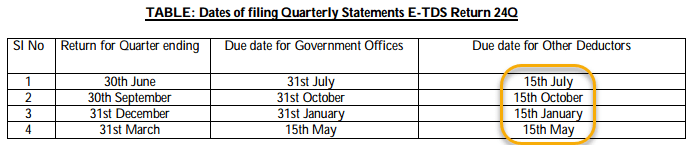
The due dates for Form No. 24Q filing, presented in the circular, seem to be incorrect. The circular presents the due dates for non-government deductors as follows.

table24q

However, the Income Tax Department, by way of a notification dated 29-Apr-2016, revised the due dates (with effect from 01-June-2016) for Form No. 24Q filing each quarter as follows.

Quarter Deadline
First quarter, ending 30th of June Immediately following 31st of July
Second quarter, ending 30th of September Immediately following 31st of October
Third quarter, ending 31st December Immediately following 31st of January
Fourth quarter, ending 31st of March Immediately following 31st of May

The circular seems to contain the due dates which were in effect prior to the above notification.

Para 9.2 in the circular

According to para 9.2 in the circular, “rebate as per Section 87A upto Rs 2000/- to eligible persons (see para 6) may be given.”

This seems to be a mistake since the maximum rebate under Section 87A for FY 2016-17 is Rs 5,000 and not Rs 2,000. In fact para 6 (referred to in para 9.2) in the circular states the correct amount (Rs 5,000).

Suggestions

1. It would help if the Income Tax Department releases the salary TDS circular well ahead of the last quarter of the year. Many organizations initiate the process of investment proof scrutiny in January and hence need adequate time to study and implement the guidelines in the circular.

2. While it is fine to copy text from the previous year’s circular for the sake of convenience, it would help if the Income Tax Department does a thorough check on whether changes to income tax procedures for the current year are presented accurately in the circular.

Read more

PF Electronic Challan cum Return (Version 2.0)

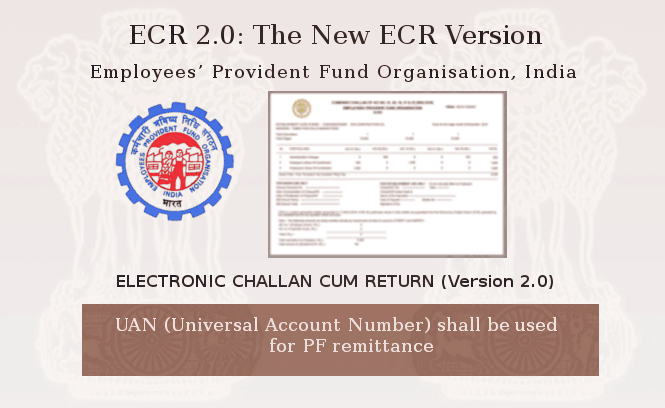
The Employees’ Provident Fund Organization has made significant changes to the processes related to generation of the Electronic Challan cum Return (ECR) file. From now on, the Universal Account Number (UAN) shall be the unique identifier for PF remittance, transfer and withdrawal. The process of using the PF number as the identifier has been done away with. The PF department calls the new ECR version “ECR 2.0”.

The PF Department introduced the system of UAN for each member in 2014. However, employers have been using the PF number as the unique identifier for PF remittance since PF-ECR has not required UAN for remittance until now. Also, despite the PF Department’s repeated insistence, many employers have not been completing the formalities related to UAN – not assigning UAN to employees and not completing the KYC formalities for employees. Given that UAN was required only for withdrawal and transfer of PF, many employers have not been showing any urgency with regard to completing UAN formalities at the time of an employee joining the organization.

This has now changed.

ECR2.0

Generate/record UAN at the time of employee onboarding

Given that PF remittance cannot be carried out without the UAN, employers need to record the UAN of an employee as soon as they join the organization.

a. Employees who are joining PF for the first time

The employer needs to log into the PF portal, enter information such as name, name of father/spouse, date of birth and generate the UAN online. The UAN shall be used for PF remittance.

b. Employees who were members of PF prior to joining your organization

The employer needs to “link” the existing UAN of the member to the employee record on the portal.

Changes to the ECR

The format for the ECR has undergone significant changes.

1. Reduction in the number of fields

The earlier ECR format had 25 fields while the new format has only 11 fields. The membership ID field has been discarded since the UAN has been introduced. Employee attributes such as date of birth, gender, father’s name, date of joining and exiting PF have been discarded from the ECR since such attributes are to be updated on the PF portal separately.

2. Separate ECR for arrear PF

The PF department has introduced a separate ECR format for remittance of arrear PF. The arrear ECR contains 8 fields such as arrear wages, employee share, and employer share.

3. Gross Wages

The PF department has introduced a new field called “Gross Wages” in the ECR. The term Gross Wages, as per the documentation released by the PF department, refers to “total emoluments payable to the employee in the wage month for which the ECR is being filed.” We presume this is nothing but the gross pay of an employee including salary heads such as HRA which are left out for PF calculation. In case you include non-salary reimbursements as part of payroll, please deduct such amounts from the gross pay in order to arrive at the Gross Wage for the purpose of PF ECR.

In case there is a significant difference between EPF wage and the Gross Wage for employees whose salary is below Rs 15,000, the PF department could seek an explanation for the same.

Please note that the Gross Wages amount cannot be less than the EPF wages amount.

4. EPF Wages

According to the documentation released by the PF department, EPF wages refer to the “wages on which the employer is supposed to remit the dues. (If the employer is restricting the dues on wage ceiling of 15000 and the employee is contributing on his full wages above 15000/- then 15000 should be shown as EPF wages. In case the employer is paying his dues on above wage ceiling, that wage should be entered.”

The definition of EPF Wage for the new ECR format is somewhat puzzling. Currently, we compare the 2 wages on which we calculate the employee and employer PF contribution and take the higher wage as the EPF wage for the purpose of ECR. For example, if the employee’s contribution is calculated as 12% of 20,000 (say, the employee’s basic wage) and the employer contribution is calculated on Rs 15,000 (restricted wage), we calculate the administration charges on Rs 20,000 and show Rs 20,000 as the EPF Wage in the ECR. As per the new ECR guidelines, the wage on which the employer contribution is calculated will have to be shown as EPF Wages (Rs 15,000 in the example). This is odd since if we show the employer PF wage as the EPF Wages, there will be no apparent relationship between the EPF Wages and the administration charges (at least in the example stated above).

5. NCP Days

According to the documentation, the NCP days figure has to be in number of full days and half day NCP is not permitted. This too is puzzling since organizations widely apply half day loss of pay on PF calculation. If we have to round-off NCP days for the purpose of ECR upload, there would be no connect between the PF amounts and the NCP days in case of half day loss of pay. We wonder why the department decided not to allow 0.5 days (or multiples of it) for NCP days.

6. ECR shall not expire

Earlier, ECR files had validity for a certain number of days after which they expired. In the new portal, ECR files do not expire. Here is an excerpt from the PF document.

Question 6: In how much time the uploaded ECR will lapse if payment is not made?

Answer: The ECR will not lapse now. You can make the payment after uploading the same through the online payment link. However for the delay beyond the due date the applicable rules on Damages and Interest will apply.

Useful links

Process flow description for generation of new ECR: Download.
ECR 2.0 FAQ: Download
ECR 2.0 file format: Download

Read more

An employee by any other name

What’s in a name? that which we call a rose
By any other name would smell as sweet;

– William Shakespeare in Romeo and Juliet

While it is perfectly legitimate for organizations to hire consultants (along with hiring full-time employees) during the course of business, it is important that the underlying statutory requirements are fully adhered to. We find many organizations not calculating salary-related statutory deductions such as income tax, PF and ESI for personnel they classify as consultant. Just because the title of consultant is used does not automatically make a person non-employee. Authorities, in a variety of cases, have gone beyond mere titles given to work personnel to examine whether the underlying relationship between an individual and the organization is that of employee and employer.

TDS – Under section 194J or 192 of the Income Tax Act?

In a case (ITA No. 747/2009) involving a health care organization and the Income Tax Department, The High Court of Karnataka has provided guidelines for ascertaining the nature of relationship between an individual and his employer. In the said case, the assessee (health care organization) deducted TDS for payments made to consultant doctors under Section 194J (TDS on fee for technical services). The Income Tax Department argued that the TDS should have been deducted under Section 192 (TDS on salary) since the nature of relationship between the consultant doctors and the assessee organization was that of employee and employer.

The Honourable Judges, in their verdict, said:

13. To decide the relationship of employer and employee we have to examine whether the contract entered into between the parties is a ‘contract for service’ or a ‘contract of service’. There are multi-factor tests to decide this question. Independence test, control test, intention test are some of the tests normally adopted to distinguish between ‘contract for service’ and ‘contract of service’. Finally, it depends on the provisions of the contract. Intention also plays a role in deciding the factor of contract. The intention of the parties can also determine or alter a contract from its original shape and status if both parties have mutual agreement. In the instant case, the terms of contract ipso facto proves that the contract between the assessee-Company and the doctors is of ‘contract for service’ not a ‘contract of service’.

The courts of India, including the Supreme Court, have gone into the issue of whether the relationship between an individual and his employer can be said to be that of employee and employer in several cases. The key factors considered by courts in this regard are as follows.

a. Control
Does the employer exercise significant or absolute control over the day to day functioning of the individual? For example, does the individual have any flexibility in work timings? Does the individual work on the basis of specific tasks (such as those in a short-term project) or does the individual have to commit a certain period of time to the employer irrespective of the actual work done? Does the individual work under the complete supervision of managers in the employer organization or can the individual work independently to achieve work objectives?

The more the control exercised by an employer on an individual’s daily work routine, the more the individual’s role can be characterized as that of an employee’s.

b. Payment of remuneration
Does the individual receive a fixed remuneration on the basis of hours spent or a variable remuneration on the basis of certain work outcomes? An individual can be characterized as an employee if the remuneration has a significant fixed component.

c. Applicability of services rules
If the contract with consultants contain terms which resemble the service rules which govern employees, the statutory authorities could well argue that the consultants are in fact employees.

d. Independence to work for other employers
Organizations typically require employees to sign an exclusivity agreement that bars them from working for other employers while in service. Consultants, in most cases, are independent to pursue multiple work opportunities across employers at the same time.

e. Service duration
An individual who is employed for short periods of time on a sporadic basis is more likely to be a consultant than an employee (who is more likely to be hired on a permanent basis).

In a recent ruling (Appeal No. Income Tax 572/Bang-2014), a Bangalore bench of the Income Tax Apellate Tribunal, said that the assessee incorrectly deducted TDS under Section 194J instead of Section 192 on account of the assessee misclassifying employees as consultants. The Tribunal Bench, after going through the terms of the contract between the assessee and the individuals hired as consultants said, “All these conditions go to prove that it is a case of contract of service.” The term Contract of Service, as you would appreciate, refers to employer-employee relationship.

The Bench in the above case also stated that mere title (such as Consultant) does not change the nature of the relationship. To quote from the ruling,

All these circumstances go to prove that the assessee is only making an attempt to camouflage real nature of the transaction by using clever phraseology. It is not the form but the substance of the transaction that matters. The nomenclature used may not be decisive or conclusive to determine the nature of transaction. The intention of the parties is to be ascertained with reference to terms of conditions contained in the agreement.

Hire consultants, but..

If your business requires hiring consultants, do so by all means. However, do not create a category of work personnel called consultants with the sole objective of avoiding statutory deductions such as PF and ESI. The PF and ESI authorities can and do examine whether exclusion of any of the work personnel is on valid legal grounds.

The Supreme Court of India (in Royal Western India Turf Club Ltd. Vs. E.S.I. Corporation), while commenting on exclusion of certain types of personnel from ESI, said:

The definition of “employee” is very wide. A person who is employed for wages in the factory or establishment on any work of, or incidental or preliminary to or connected with the work is covered. The definition brings various types of employees within its ken. The Act is a welfare legislation and is required to be interpreted so as to ensure extension of benefits to the employees and not to deprive them of the same which are available under the Act.

In other words, please be clear about the legal basis when you keep a person out of statutory deductions such as PF and ESI.

Finally, please make sure that your organization’s agreements with consultants contain terms which, beyond any doubt, denote that the relationship is one of “contract for service” and not “contract of service”.

Read more

ESI wage ceiling enhanced to Rs 21,000

The Ministry of Labour and Employment has, by way of a gazette notification, enhanced the ESI wage ceiling from Rs 15,000 per month to Rs 21,000 per month. This comes into effect from 01-Jan-2017.

As you are aware, the current limit is Rs 15,000 – in other words, employees who draw an ESI wage of more than Rs 15,000 cannot come under ESI currently. With effect from 01-Jan-2017, employees drawing an ESI wage of up to Rs 21,000 will need to become ESI members.

As far as your organization is concerned, you may see some of the current employees (whose salary is between Rs 15,000 and Rs 21,000) getting into ESI for the first time on account of the wage ceiling enhancement. Also, there could be an increase in the cost to company on account of employer ESI contribution to such employees (who get added to ESI).

Please implement this in payroll with effect from January 2017. Kindly consider the new wage ceiling for final settlement processing too.

Read more